KEY TAKEAWAYS FROM UKRAINE RECOVERY CONFERENCE 2026
Updated: Jul 24
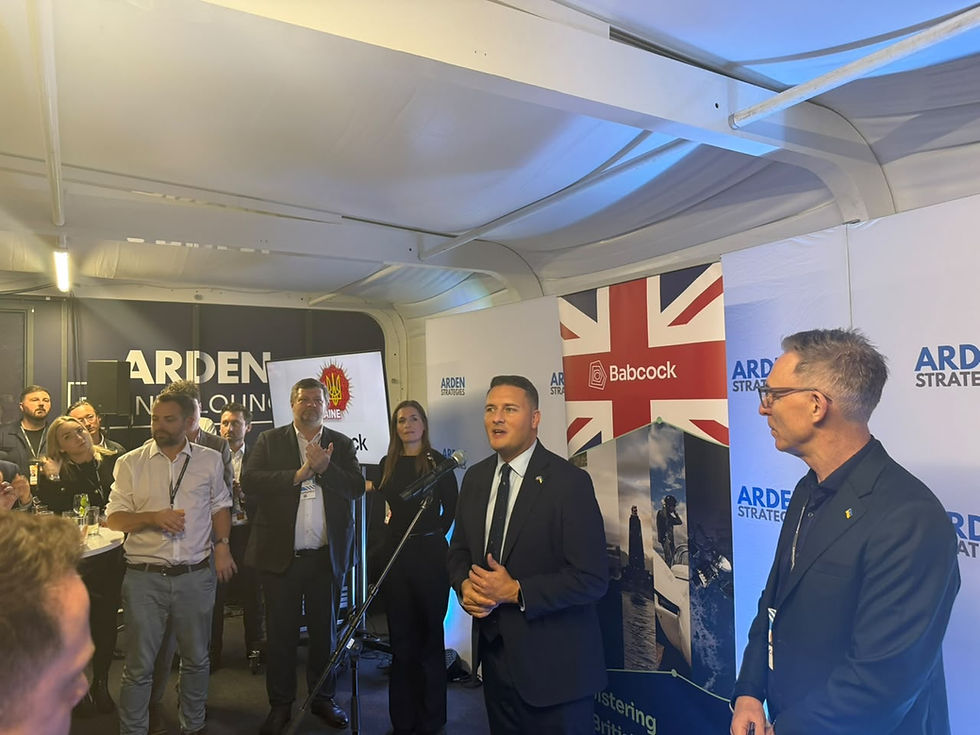
UBBC Reception at House of Lords 16 July 2026 – Mark Irwin
Baroness Nicholson, distinguished guests, ladies and gentlemen, may I begin by echoing Christophe’s thanks to everyone joining us this evening. I would also like to acknowledge our members for their continued support of the vital work the UBBC is doing to foster productive, rewarding and long-term relationships between UK businesses and our partners and friends in Ukraine, who continue to fight for their freedom and their future with unyielding courage more than 1,600 days since Russia’s full-scale invasion.
As Christophe mentioned in his introduction, Ashley Goodall and I had the privilege of representing the UBBC at the Ukraine Recovery Conference 2026, held in Gdansk on 25 and 26 June.
URC26 marked an important transition in the international approach to Ukraine’s reconstruction: a clear move from broad political commitments to implementation, investment mobilisation and meaningful private-sector participation.
Where previous conferences focused heavily on planning and pledges, Gdansk was defined by practical financing mechanisms, commercially focused partnerships and a much clearer emphasis on delivery.
The central message was clear: Ukraine’s recovery is no longer being seen simply as a humanitarian or donor-led effort. It is increasingly understood as one of the largest long-term investment opportunities in Europe, with private capital expected to play a substantial role alongside governments, multilateral institutions and development finance organisations.
The scale of the challenge Ukraine faces is unprecedented, with current estimates suggesting reconstruction needs of more than half a trillion dollars in the years ahead. No combination of public budgets, grants or concessional finance alone will be sufficient to meet that requirement.
Success will therefore depend on mobilising institutional investors, strategic corporate investors, infrastructure funds and private equity alongside continued public-sector support.
That shift in thinking was evident throughout the conference.
Reconstruction is increasingly being used as a mechanism for accelerating EU integration with emerging programs expected to comply with:
· EU procurement rules
· Governance reforms
· Anti-corruption standards
· Environmental regulations, and
· Competition policy.
Over the two days of the conference, agreements representing over €10 billion of commitments were announced. Equally significant, however, was the nature of those commitments.
Rather than relying solely on grant funding, increasing emphasis is being placed on financial mechanisms, including the evolution of innovative risk-sharing structures designed to make investment commercially viable.
Political risk insurance, first-loss guarantees, blended finance, export credit support and participation by multi-lateral development banks are all intended to improve both delivery outcomes and risk-adjusted returns for investors.
Alternative public-private partnership models are also emerging as an important part of the solution. Rather than expecting investors to solely absorb sovereign, security and demand risks, governments and international financial institutions are adapting traditional PPP structures so that risks are allocated to the parties best able to manage them.
This creates the potential for commercially sustainable projects while protecting the public interest. These hybrid financing models are likely to become increasingly important across energy, transport, municipal and other social infrastructure projects.
Alongside these financing developments, there are equally important structural reforms taking place within Ukraine itself.
Amongst these, the Government continues to advance an ambitious privatisation programme through the State Property Fund, viewing private ownership as a catalyst for investment, improved governance and faster economic recovery. The objective is not simply to dispose of state assets, but to attract strategic investors capable of modernising businesses, improving productivity and integrating them into European markets.
Two examples illustrate the breadth of this opportunity.
The first is Ocean Plaza, one of Kyiv's newest and largest shopping centres. Following the confiscation of the asset from sanctioned Russian interests, it is
being prepared for competitive sale through the SPF to return a commercial enterprise to an ownership model best qualified to create long term value.
The second is the United Mining and Chemical Company, Europe's largest producer of titanium and zirconium concentrates. More than a mining investment, UMCC represents access to strategically important supply chains supporting aerospace, advanced manufacturing, energy technologies and defence industries. It is an example of how privatisation is being used not only to raise capital but to strengthen Ukraine's industrial competitiveness and strategic resilience.
When people think about opportunities in Ukraine today, much of the focus understandably falls on its remarkable innovation in military technology, particularly unmanned aerial systems. MilTech and dual-use technologies will undoubtedly remain important and continue to attract significant investment.
However, the opportunity extends far beyond defence.
Rebuilding Ukraine requires reconstruction of its entire economic and social infrastructure.
Energy clearly remains one of largest investment opportunities, including electricity generation, grid modernisation, and energy resilience.
Transport and logistics will require significant investment in railways, ports, border crossings and freight corridors as Ukraine becomes increasingly integrated with European supply chains.
URC26 also placed substantial emphasis on municipalities. European local government organisations stressed that successful reconstruction depends on empowering regional and municipal institutions.
In this regard, housing, healthcare, schools and municipal infrastructure will be at the heart of nation rebuilding.
There are also substantial opportunities across digital infrastructure, telecommunications, water and wastewater systems, industrial manufacturing, critical minerals, agribusiness, environmental remediation and the wider built environment.
For businesses involved in engineering, infrastructure, construction and professional services, Ukraine represents one of the most significant infrastructure markets likely to emerge anywhere in Europe over the next decade.
To conclude, perhaps the most important takeaway from this year’s conference is that reconstruction is no longer viewed as something that begins after conflict ends.
It is happening now. Investment frameworks are being established now. Institutional reforms are being implemented now. And companies that begin building relationships, work to understand procurement processes and develop local partnerships now will be best positioned as larger programmes come to market.
The message from URC26 was therefore about far more than reconstruction. It was about economic transformation.
Ukraine is progressively opening sectors of its economy to private ownership,
introducing sophisticated risk-sharing mechanisms, developing investable project pipelines, aligning regulation with European standards and navigating the complexity of successfully balancing risk with commercial return while delivering long-term economic and social value.
If that balance can be achieved, Ukraine's recovery has the potential not only to rebuild a nation, but to create one of Europe's most significant investment and growth stories for a generation.