Conservative Party Conference Report 2026

In clear contrast to Labour's conference, the Conservative Party Conference had a very different focus, tone and audience. From the outset, the key panels and themes centred on the economy, business, defence and foreign affairs, with a strong emphasis on the City, entrepreneurship, investment and restoring the UK's competitive advantage.
Delegates were predominantly dressed in business attire, and the conference appeared particularly focused on working professionals aged between 30 and 60. The party is reinventing itself while returning to classic Conservative themes: fiscal discipline, controlling the growing welfare bill and national debt, rewarding investment and hard work, encouraging competition, and creating the conditions for growth and economic renewal.
Kemi Badenoch emerged as the undisputed leader, with strong backing from delegates and support from prominent external voices, including Matthew Syed, who delivered an exceptional philosophical speech on compassion and the importance of not insulating capitalism from failure. Jeremy Clarkson also spoke out in support of British farmers.

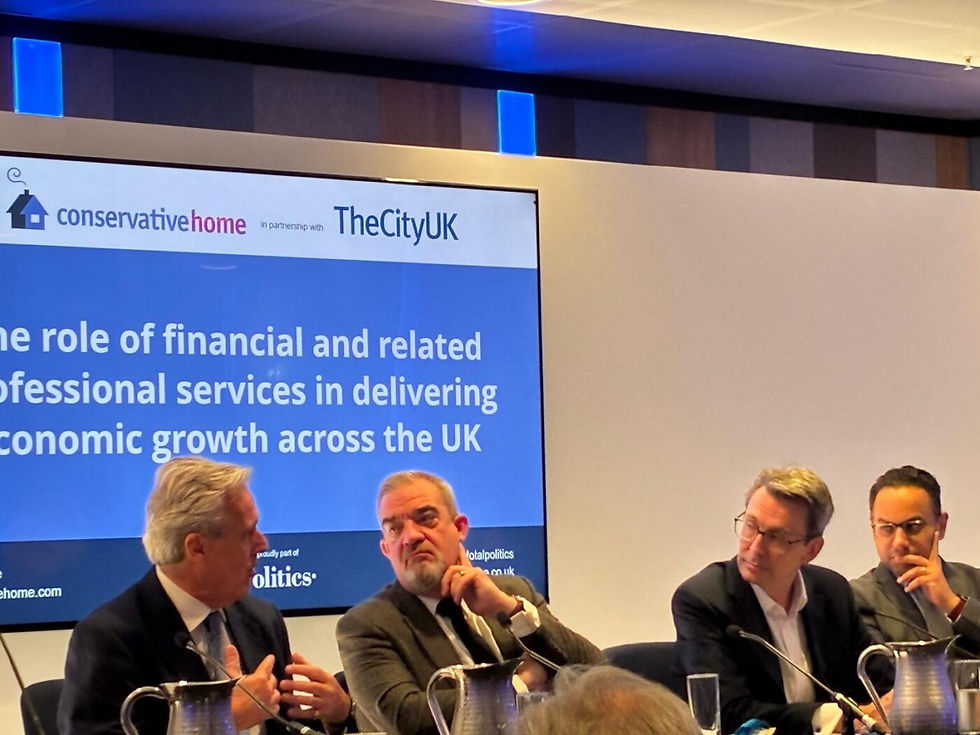
Andrew Griffith, the new Shadow Chancellor of the Exchequer, maintained a high profile throughout the conference. We saw him at events hosted by the Lonon Chambers of Commerce and the Growth Commission, where he outlined the principles of deregulating business, encouraging greater risk-taking and investment, progressively reducing taxes, and cutting welfare expenditure, particularly in relation to young people not in education, employment or training (NEETs).
The overarching message was one of 'tough love': encouraging the estimated one million young people classified as NEETs into employment, while creating an environment in which entrepreneurs are incentivised to remain in the UK, invest and grow their businesses.

Sir James Cleverly, who is seeking the Conservative nomination for Mayor of London, continued this theme, highlighting the need to build more housing for London's young workers and ensure that the capital's infrastructure functions effectively. He argued that London competes internationally with Dubai, Singapore, Paris and Berlin for business and investment, rather than with Manchester.
He emphasised that when London flourishes, the whole of the UK benefits, and warned that the capital risks declining under Labour.
TheCityUK and Mark Garnier, the Shadow City Minister, discussed the importance of appropriate deregulation, balanced against the UK's reputation as a safe, stable and well-regulated environment for international business. Interestingly, representatives of the Financial Conduct Authority (FCA) acknowledged that there are areas where reducing regulation could help encourage economic growth.
Foreign Affairs, Defence and Ukraine

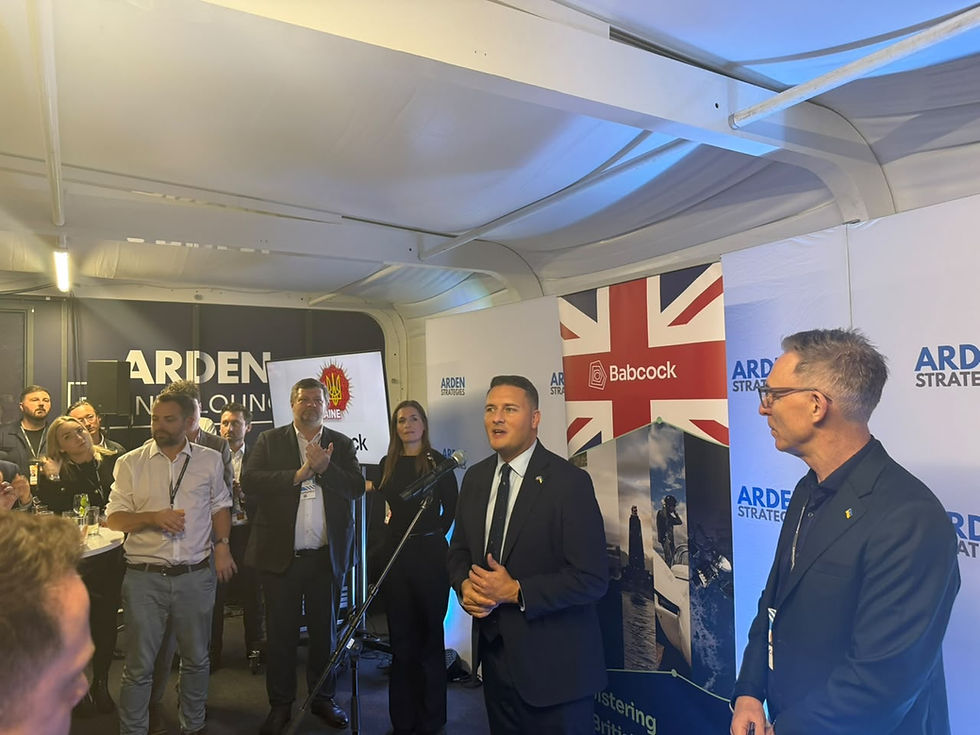
The foreign affairs and defence teams attended a major rally in support of Ukraine, where Tom Tugendhat, the Shadow Foreign Secretary, argued that supporting Ukraine is fundamentally a Conservative issue: defending individuals, families, communities and national sovereignty. He stressed that protecting Ukraine is also essential to protecting our own borders and security from Russian aggression.
James Cartlidge, the Shadow Defence Secretary, announced a commitment to developing a UK air and missile defence shield, known as the Britannia Shield, alongside a pledge to increase defence spending to 3% of GDP by 2030.
Sir Iain Duncan Smith rallied delegates behind Ukraine and invited us to discuss UKDF with him.

Ukrainian parliamentarian Yehor Cherniev, a member of the Verkhovna Rada, spoke passionately about the urgent need to provide Ukraine with the weapons required to defend itself. He highlighted the rapid technological innovation necessary to counter Russian drones and the importance of scaling up defence production in partnership with countries such as the UK.
Jack Lopresti, a former Conservative MP, brought two representatives of the Azov Brigade to discuss battlefield innovation and the treatment and torture of Ukrainian prisoners of war by Russia.
Meanwhile, Brooks Newmark and Bob Seely presented the capabilities of their British-Ukrainian defence technology company, Trypillian, and its work supporting Ukraine through the development of advanced drone and battlefield technologies.
Tom Tugendhat also spoke at the EU Ambassadors' Reception, where he encouraged businesses to establish themselves in the UK to develop new technologies and innovation. The ambassador spoke warmly about the importance of continued cooperation and trade between the UK and the European Union.
Middle East and Iran
The Conservative Middle East Council (CMEC) attracted full audiences to its discussions on Islam and the evolving situation in Iran.
In a session featuring Dr Lina Khatib, an important distinction was drawn between Islam as a religion and Islamism as a political ideology.
A separate discussion on Iran featured Sir Nicholas Hopton, who criticised President Trump's approach to military action against Iran. He argued that the US administration had failed to consult sufficiently with those who understood the Iranian regime, its internal dynamics and its strategic thinking before launching attacks.
In his assessment, the resulting war had been disastrous, with far-reaching consequences for regional stability, perceptions of the United States and Trump's own standing in the polls.
He emphasised the resilience of the Iranian regime and the difficulty of predicting what might emerge from the conflict. The Gulf states, meanwhile, had been deeply traumatised by Iran's unexpected attacks, particularly given their efforts to manage relations with Tehran through diplomacy.
Looking ahead, he argued that the United States should seek a negotiated settlement with Iran, consider easing primary sanctions and revisit the memorandum of understanding discussed during the summer. Without a diplomatic agreement, he warned, the conflict was likely to continue.
Political Outlook and Electoral Prospects
Finally, Sir John Curtice, the leading political scientist and psephologist, offered an assessment of the Conservative Party's electoral prospects.
He observed that while Kemi Badenoch is increasingly regarded as a strong and respected leader, her personal standing has moved ahead of that of the Conservative Party itself. The party now needs to close this gap and rebuild its relationship with the wider electorate.
Reform UK remains a major challenge for the Conservatives, particularly because many of its supporters are deeply conservative on cultural and national identity issues, having voted Leave in the Brexit referendum, but hold economic views to the left of traditional Conservative policies.
Although progress has been made under Badenoch's leadership, Curtice emphasised that the party still needs to make significantly greater inroads with the wider public if it is to restore its credibility as a credible alternative government.
Overall, the conference demonstrated a Conservative Party seeking to renew itself around economic growth, fiscal discipline, business competitiveness and national security. There was a clearer sense of purpose and unity behind Badenoch's leadership, but the central challenge remains translating that renewed confidence among party members into broader public support.